Start to finish
Airborne fast, and a plain answer on what was covered
On the day
What happens when you call
- Step 1
The call
Where, who or what is missing, how long, what ground has already been searched, and whether the police or a search coordinator are already involved. This takes minutes and decides everything that follows.
- Step 2
Airspace and access check
A quick check for any restriction already in force over the area, including a police or coastguard operation, a nearby aerodrome, or a restricted zone. Where a search is already coordinated, flying happens under that coordination, inside whatever limits are set.
- Step 3
The flight
A methodical pass over the agreed ground, visual camera first where light allows, thermal alongside it or as light drops. The route is planned to cover the ground properly rather than flown by eye on the day.
- Step 4
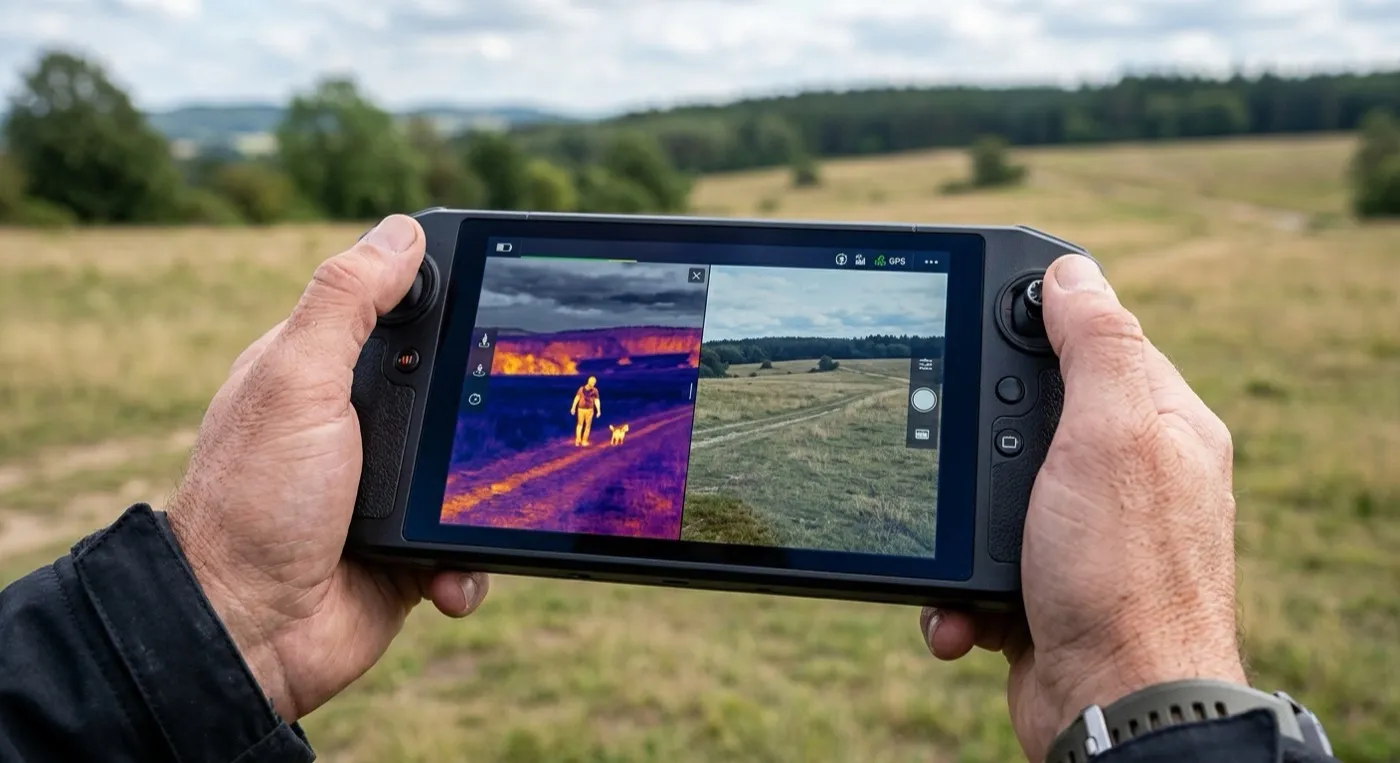
The screen, watched live
Both camera feeds are monitored in real time while the aircraft is airborne, not reviewed afterwards. Anything worth a closer look gets a second pass immediately.
- Step 5
The call back
Anything found is reported straight away by phone with a location, to whoever is coordinating the search or to the person who called. This does not wait for the flight to end.
- Step 6
Stand-down and the note
Once the search is stood down, or the aircraft has covered what it safely can, a short written note of ground covered follows, useful for a family, a search coordinator or an event safety file.
The report
What thermal actually shows
A warm body against cool ground
The clearest read a thermal camera gives. A person or an animal shows as a bright shape against grass, bare rock or open field, especially once the ground itself has cooled in the evening.
Strongest at dawn, dusk and after dark
The bigger the temperature gap between a body and the ground around it, the clearer the image. Early morning and after sunset are when that gap is widest.
Weaker on a hot day
Once the sun has warmed open ground for a few hours, the contrast between a body and its surroundings drops, and thermal becomes far less useful until the ground cools again.
Cannot see through canopy or water
Dense woodland, thick gorse and any body of water block the camera the same way they block the eye. That ground needs a different approach, and it is said plainly rather than glossed over.
The visual camera fills the gaps
In daylight and open conditions the 100 megapixel visual camera covers ground the thermal camera is weakest on, and the two are flown together wherever the light allows it.
What was and was not covered
Every flight ends with a plain statement of the ground actually assessed, so a decision about what to search next is based on fact rather than assumption.
Why speed matters here
A search gets harder the longer it runs: light drops, weather turns, and ground that was searched once needs searching again if conditions changed. The aim is to be airborne the same day, usually within the hour of the call, because an aircraft in the air an hour earlier is ground covered an hour sooner.
Weather and rules
The bits that decide whether a flight happens
Wind
Strong wind, particularly gusting across open moor or along a cliff edge, makes the aircraft harder to fly precisely and the image less stable. A flight in properly unsafe wind is refused rather than attempted, because a crashed aircraft helps nobody.
Rain and low cloud
Heavy rain and cloud low enough to sit on the moor both stop a flight: water on the lens ruins the image and low cloud removes the ground from view entirely. Drizzle and damp are usually workable.
Light
Thermal is strongest at dawn, dusk and after dark. The visual camera needs enough daylight to be useful. Between the two, most of a 24 hour period can be covered, but the choice of camera on any given flight depends on exactly when it happens.
Airspace and existing operations
Some ground sits inside a flight restriction zone around an aerodrome or under other restricted airspace, and a live police or coastguard operation, which may include a helicopter, changes what is safe to fly and where. Both are checked before take-off, not discovered mid-flight.
What is underneath
The A2 Certificate of Competency allows closer operation near uninvolved people and buildings than the basic category, which matters near a search command point or a gathered crowd at an event. It still means thinking carefully about anyone on the ground below the flight path.
When a flight cannot go ahead
If conditions actually make a safe flight impossible, that is said plainly and immediately rather than attempted anyway, along with the earliest point it could be revisited.
Before you book
Common questions
- Is this a replacement for 999, the police or the coastguard?
- No, and it is never presented as one. A missing person is a 999 matter first. This is a private drone operator that assists a search alongside the emergency services, flying under their coordination when they are on scene, and it never delays or substitutes for calling 999.
- How quickly can the aircraft be in the air?
- Usually within the hour of the call, once the location and a safe, lawful take-off point are agreed. Distance from Exeter and any airspace or existing-operation check can add a little time, and that is explained plainly on the phone rather than promised as a fixed figure.
- What does thermal actually show?
- A warm body against cool ground, which reads clearly at dawn, dusk and after dark. It does not see through dense woodland canopy, deep cover or water, and it is far less useful on a hot day once the ground itself has warmed. All of that is explained before booking, not after.
- How much does this cost?
- A fixed price, agreed on the phone once the ground and rough area are known, before anyone sets off. No figure is quoted here because it depends on the size and shape of the search area on the day.
- Can you fly at night?
- Yes, and thermal is at its strongest then. Flying after dark still needs the same airspace and safety checks as a daylight flight, and where conditions do not actually allow it, that is said plainly rather than attempted regardless.
- Do you need permission to fly over private land?
- Yes, for the land being searched and for the take-off point. Where the caller is not the landowner, permission is sorted before the flight rather than assumed, and this is usually quick where there is genuine urgency.
- What happens if the weather is bad?
- If wind, rain or low cloud make a safe flight actually impossible, that is said plainly and immediately, along with the earliest point conditions might allow another attempt. A flight is never forced through unsafe weather for the sake of it.
- Will you hand over the footage to the police?
- Yes, where the police or a search coordinator need it. Full raw footage and stills are available, not just a summary.
See how a search is flown
Call now, same day with Drone Search and Rescue
Call with the location and what has happened. Sam Hembury will come back with a fixed price and get airborne as soon as it is safe to.